


Chef Victor Rivera: Community, Discipline, and the Pursuit of Excellence
Article by: Kristin L. Wolfe | Photography by Yumi Matsuo | Published September 14, 2026
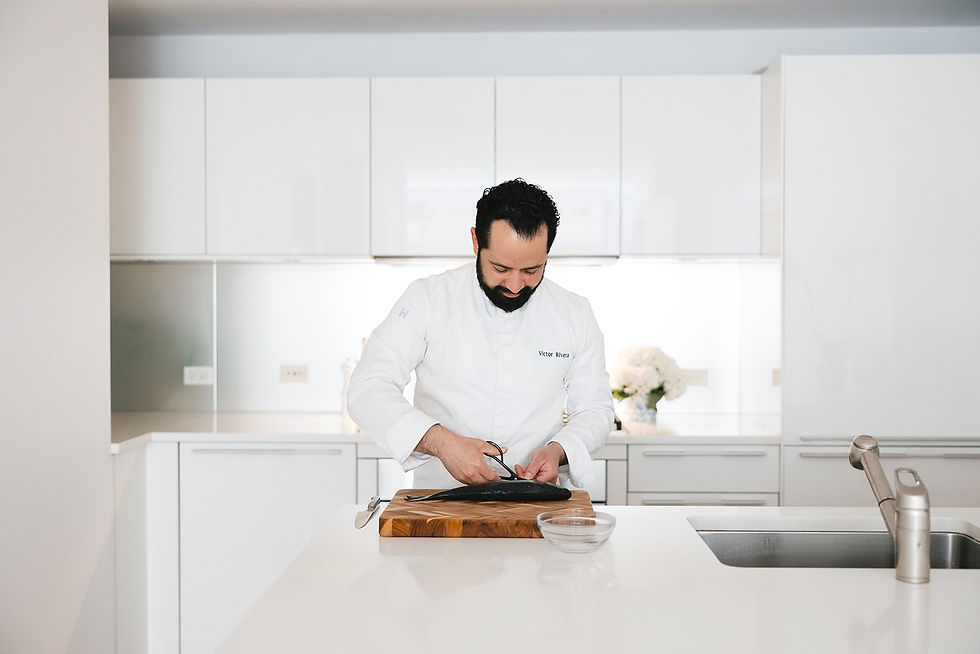
Before Chef Victor Rivera ever led the kitchen at Bazaar Meat in New York City, he grew up in a Puerto Rican household in Miami where food was an open invitation. Friends wandered in, neighbors stopped by, and no one left hungry. Long before he learned fine-dining technique, Rivera learned that food's greatest power is its ability to bring people together.
Coming out of a quick elevator ride in the Ritz-Carlton NoMad into the dimly lit yet rich expanse of Bazaar Meat, only the unpeopled booths (and my need for an espresso) reveal the early hour of the day. Otherwise, the pace of the staff—walking to and from the kitchen, dressing tables, and tidying their uniforms—would easily signal the frenzy of a pre-service dinner prep. There were still several hours before the dinner rush would begin, but everyone was already in “go” mode. Despite the endless to-do list, Executive Chef Victor Rivera greeted me with an almost alarming sense of calm.
Sporting a trimmed beard against crisp chef whites, Rivera carries himself with the quiet confidence of someone who has spent more than half his life in professional kitchens. The restaurant world is not for everyone; burnout, fatigue, and physical or mental health issues often come with the territory. It’s a reality Rivera knows all too well, which is why he has learned to foster a healthy lifestyle to keep the “decay” at bay—something he believes is still a major issue in the industry.
The level of calm Rivera greeted me with is part of a “warrior” mentality he believes is necessary to manage a business that, on the outside, seems to thrive on the edge of chaos. It is a world where mayhem submits to discipline and order.
The composure he projects today was earned over nearly two decades of experience.
“You have to have grit and really embrace a warrior lifestyle when you know what you're up against. Every day it's a battle within yourself. You just have to keep fighting.”
Yet Rivera's story begins far from the polished dining rooms of New York.
Raised in a Puerto Rican family in Miami, Rivera grew up in a home where food functioned as both nourishment and community.There is always that one friend who has the “fun” or “adventurous” house, where you can play video games longer than you should or stay up extra late. But when you were hungry? It was at Rivera's house where his mom and abuela fed all the kids who congregated. Surrounded by pots of slow-roasting, herbaceous pernil and endless pans spilling over with sofrito, it is no wonder that Rivera’s home became a neighborhood nucleus.
Although cooking as a career didn’t cross his mind until years later, the community established under his childhood roof worked its magic subconsciously. “Our door was always open. People from four or five houses would always come over. Even our super would come up for food. It was such a community thing,” he recalls. It was an experience that would eventually underscore his entire world.
Ironically, Rivera did not initially envision a culinary career. Inspired by an uncle who worked for the FBI, he entered college intending to pursue a similar path. But by the age of 20, he had already spent five years working in restaurants.
What started as a way to earn extra money gradually became something much more meaningful.
“I remember exactly where I was when I decided the kitchen was where I wanted to be,” Rivera says.
While working at Nikki Beach, Rivera learned every position in the restaurant. He quickly grew accustomed to the high-volume style of a kitchen that easily handled upward of nearly 1,000 covers in a night. Running back and forth from the kitchen to the beach, he immersed himself in the hustle, eventually finding the flow that made it all work.
“Even though it was very difficult, I was drawn to that chaos,” he says. “But more than the chaos, I was really craving structure and discipline.”
One day, while bussing tables, Rivera looked into the kitchen and realized he wanted more than a job. He wanted a craft.
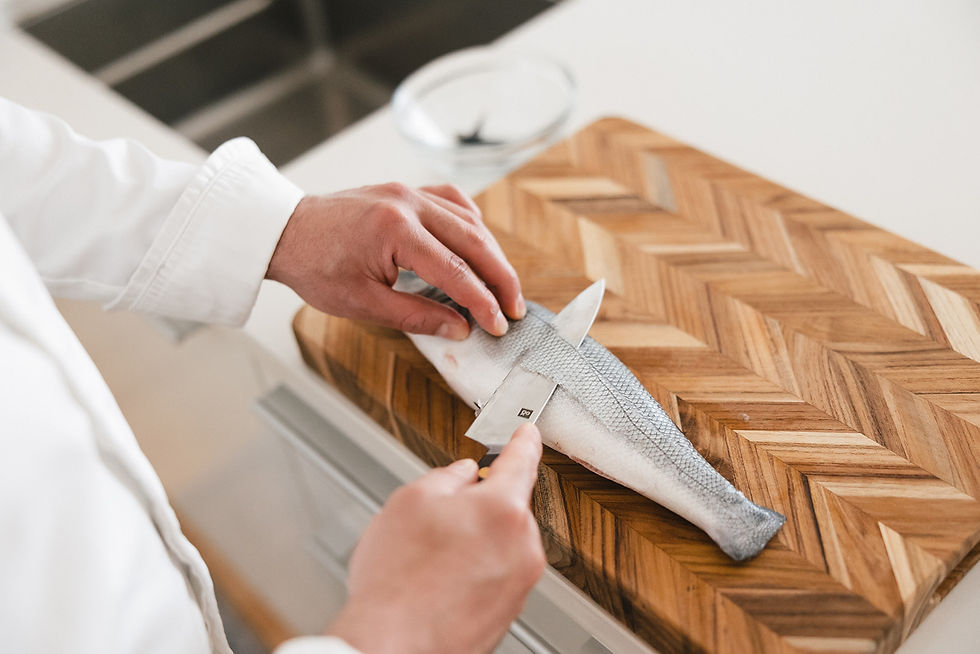
Rivera has always been studious about his passions; to this day, he keeps a continuous pile of books nearby to feed his pursuits. When he decided to make the kitchen his life's work, he read everything he could get his hands on. From Culinary Bootcamp and The French Laundry Cookbook to Charlie Trotter's: [A Cookbook] and Le Bernardin: Four Star Simplicity, he became hungry to learn and sharpen his skills. He enrolled in Le Cordon Bleu in Miramar, taking his experience and kitchen vocabulary to the next level.
As his experience grew, Rivera joined the Ritz-Carlton organization, where he was exposed to a wide range of culinary disciplines, from large-scale banquets to specialized restaurant concepts. It is a moment, he says, that remains firmly etched in his mind.
“I’ll never forget driving up to the beautiful property with my father,” Rivera recalls, “and thinking, ‘this is big time,’ and wondering if I was out of my league.”
Not only was it his league, but Rivera used every opportunity to deepen his education. Each kitchen introduced new techniques, new perspectives, and new standards. After a decade of experience along the sandy borders of Florida, he was ready to propel himself into the gritty, albeit prestigious, epicenter of New York’s culinary scene.
Staging for some of the biggest names in the business, like Eric Ripert and Masayoshi "Masa" Takayama , he was catapulted into a world of traditional kitchen brigades. It fed his desire for knowledge but challenged him in entirely new ways.
“‘Can you shuck oysters?’ Sure. I thought I was proficient. I must have shucked up to a thousand oysters at a time during brunch services before. Here? Every single oyster was sent back. ‘These are no good,’ they said. I realized this task was not just about speed. I still had a lot to learn.”
Moving between various New York and Florida kitchens, Rivera realized he was deeply intrigued by restaurant openings—that something-from-nothing magic of building a restaurant that tests your endurance, skill, and ingenuity. When Rivera got the opportunity to help open Chef Jean-Georges Vongerichten's Market at The Edition in Miami in 2014, it was a clear sign that the local dining scene was evolving. He knew it would be the experience of a lifetime.
“I thought, I have worked in New York. I’ve had hotel experience. I've worked in independent restaurants. This is a big deal.”
Serving as the perfect convergence of Rivera’s culinary experiences, the highly anticipated opening raised the stakes. “When opening a new restaurant, everything is a question,” he says. “You have to make a lot of decisions when there’s no real routine. The first year or so is trial and error, and it takes mental fortitude to do that.”
Rivera has since helped open at least five restaurants under the José Andrés Group. He has become comfortable with the weight of the culinary name he represents and the daily grind that comes with his position.
Today, as the Executive Chef at Bazaar Meat, those experiences converge.While wielding his culinary expertise—get him talking about knives and the minimalist approaches to Japanese meats—he continues to learn while passing those lessons down to his staff.
As the clock ticked closer to service, Rivera invited me to observe the daily “line-up,” where his kitchen team rallied in the dining room to discuss the crucial notes of the day. There were updates about menus, reservations, mise en place, and quick pivots regarding staff shifts.
Looking around the circle, watching each staff member shift their gaze to their leaders, there was a quiet strength about Rivera's disposition. It became clear that Rivera's leadership style is rooted less in authority than in preparation, consistency, and trust.
Nevertheless, the challenges they face each night are not without levity and warmth. It is a world where refinement coincides with precision, but Rivera prides himself on teaching his staff that despite the grit needed for this business, a love of food remains at the core of what they do.

“I want to teach my young chefs that it's not a monotonous job. It is something that you can do with elegance. And it is certainly something that you can do with pride.”
Watching the team prepare for service, it was difficult not to think back to the house where Rivera grew up. The scale may be different now, and the dining room more refined, but the underlying purpose remains remarkably familiar: feed people well, create community, and pass knowledge to the next generation.
For Chef Victor Rivera, that may be the most meaningful measure of success.


